The Rapid Response Partnership Vehicle (RRPV) consortium, through the Biomedical Advanced Research and Development Authority (BARDA), convenes government, industry, academic, nonprofit, and service-provider organizations working to accelerate medical countermeasures for emerging infectious diseases and other national preparedness priorities.
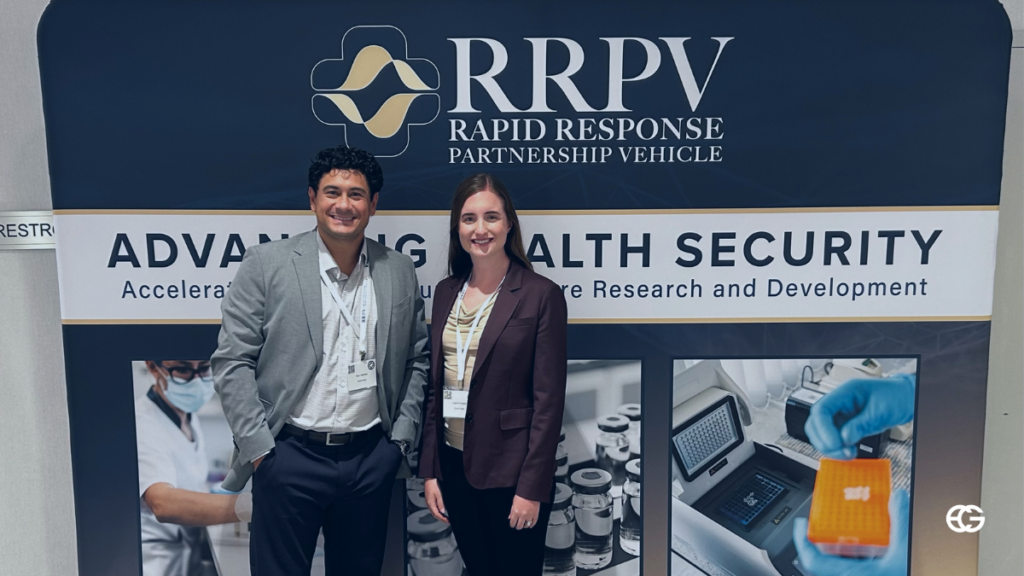
EverGlade team members Laura Powell, PhD, PMP, and Richard Merlino, MBA attended last week’s General Membership Meeting in Arlington, VA where discussions covered the work required to move medical countermeasures from technical promise to operational readiness.
Across sessions on vaccines, antivirals, diagnostics, and manufacturing, one question kept resurfacing: what does it take to turn a novel technology into a countermeasure that can be developed, regulated, manufactured, and deployed when it matters?
Four key themes stood out:
1. “Threat Agnostic” Still Requires a Defined Use Case
Broad-spectrum and threat-agnostic technologies remain attractive to the preparedness community. However, discussions suggested that broad applicability is increasingly being evaluated with greater discipline. It is not enough to say that a product could be useful against many pathogens or across multiple emergency scenarios. Developers must explain where that applicability is scientifically credible, operationally relevant, and aligned with an established priority threat space.
This distinction was evident in conversations about CBRN relevance, host-directed therapeutics, diagnostics, and antiviral development, including BARDA’s anticipated TACTIC program. For example, a host-directed therapeutic may have potential to address injury pathways shared across several infections or exposures. But a sponsor still needs to define the proposed use case: which injury mechanism is being targeted, which patient population would benefit, what endpoints could demonstrate value, and under what emergency scenario the product would be deployed.
The same principle applies to broad-spectrum antivirals. The goal may be a platform that can generate drugs against multiple viral families, but the development plan still needs a focused starting point. A program directed at a defined family, conserved viral target, or host pathway has a clearer hypothesis to test, a more manageable evidence plan, and a stronger basis for regulatory discussion than a generic “pan-viral” claim.
The practical lesson: replace broad platform language with an evidence map. Identify the priority threat, relevant mechanism, supporting data, and a realistic development and deployment pathway.
2. Commercial Development Can Strengthen Preparedness Value
Another recurring theme was the role of commercial indications and cost sharing. A commercial use case doesn’t necessarily need to be separate from a preparedness strategy. When aligned appropriately, it can de-risk development, build durable capacity, and provide evidence that is valuable for both commercial and government customers.
Commercial development can support an open IND, establish early safety data, sustain clinical operations, create manufacturing infrastructure, and help maintain a viable business case between emergency events.
The key is to show how the commercial and preparedness cases reinforce each other. A company should not attempt to retrofit an ordinary commercial product into a biodefense narrative. Instead, it should explain what the commercial pathway de-risks for the preparedness customer: Does it generate clinical evidence? Validate product performance? Sustain manufacturing capacity? Establish a distribution network or trained user base?
The discussion of “Protection Before Day One” influenza strategies provides a useful example. A seasonal vaccine that improves baseline resilience against pandemic influenza could connect routine immunization to preparedness while maintaining manufacturing capacity, infrastructure, and real-world data before an emergency. The same logic applies to products with commercial utility that also address surge, field, disrupted-care, or CBRN-response needs.
An Additional Capital Pathway
The U.S. International Development Finance Corporation (DFC) may be another relevant partner for organizations with international deployment or scale plans. DFC uses loans, loan guarantees, equity investments, and political-risk insurance to mobilize private capital for projects that advance economic development and U.S. foreign-policy and national-security priorities.
3. BARDA is Building the Evidence Engine for Antivirals
The antiviral sessions reflected a shift in how preparedness investments are structured. Rather than simply seeking more antiviral candidates, BARDA is supporting the tools, models, and development pathways needed to translate early scientific concepts into credible medical countermeasures.
The SMART Antiviral Prize and emerging PATH-SM pipeline reflect BARDA’s focus on the difficult transition from early scientific concepts to candidates supported by sufficient technical, regulatory, and manufacturing evidence. SMART moves teams from hit-to-lead work through lead optimization and IND-enabling activities, while PATH-SM is expected to support AI-enabled discovery, medicinal chemistry, in vitro evaluation, and early preclinical development for small-molecule antivirals.
The announcement of SMART program winners at the Meeting made this staged model tangible: the program recognizes that an active molecule is only the beginning.
AI-enabled discovery and NAMs, including organoids, lung models, and other non-animal systems, can help identify druggable targets, prioritize candidates, and answer focused questions about efficacy, toxicity, or tissue-specific activity. Their value depends on fit-for-purpose validation, reproducibility, and whether the resulting data reduce a meaningful uncertainty. The decision the model must support should drive its design.
4. Manufacturing Starts with Time to First Usable Product
Preparedness discussions often focus on manufacturing volume: how many doses can be produced and how rapidly capacity can scale. The RRPV Meeting highlighted an equally important metric: how quickly a credible, usable product can be generated after a new target or threat is identified.
Presenters highlighted AI-designed antibody platforms, manufacturing-relevant cell engineering, rapid formulation and process development, real-time release testing, stability prediction, and modular automation. These capabilities matter because a promising candidate can lose months to reformulation, process redesign, technology transfer, or scale-up. Building manufacturing realities into early product decisions can shorten and strengthen the path from lead selection to a usable product.
Cold-chain resilience is a similarly concrete consideration. Thermostable biologics and deployable delivery formats may be decisive in field, rural, disrupted care, or surge environments. In those settings, the practical question is not only whether a product works, but whether it can be delivered, remain viable, and be administered where it is needed.
From Innovation to Readiness
The RRPV Meeting reinforced that preparedness is an exercise in disciplined translation. The strongest programs will combine a defined use case, credible evidence plan, regulatory strategy, manufacturing readiness, and operational understanding of how the product will be used.
EverGlade helps life sciences and technology organizations connect technical innovation to federal development requirements, from opportunity positioning and teaming strategy through proposal development and post-award program execution. Connect with our team to learn more about how you can get involved.