

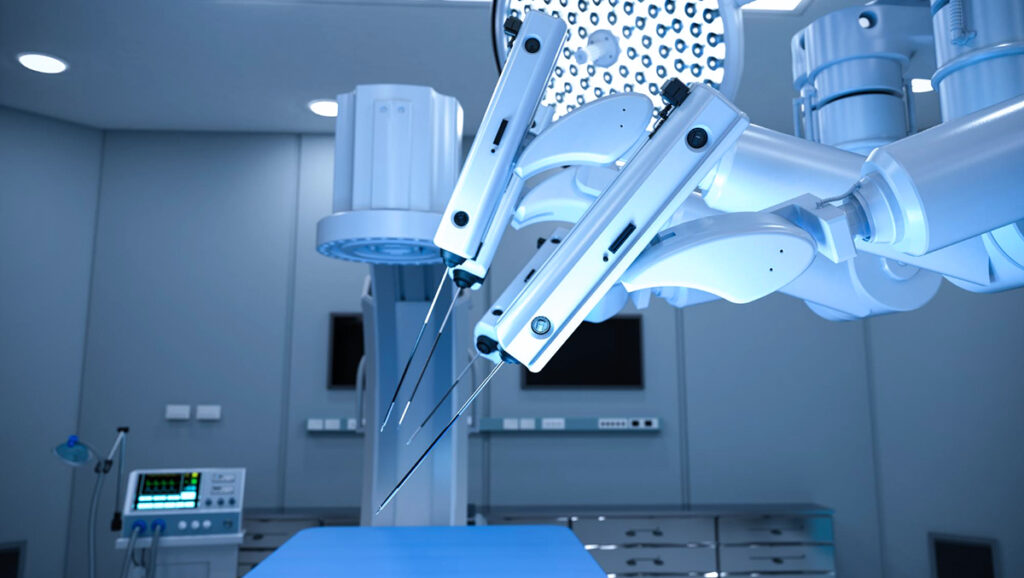
The Advanced Research Projects Agency for Health (ARPA-H) has released a major new Innovative Solutions Opening (ISO) titled Autonomous Interventions and Robotics (AIR), marking one of the most ambitious federal investments to date in autonomous surgical systems and micro-scale medical robotics. The program seeks to fundamentally redefine how clinicians diagnose and treat life-threatening conditions by developing robotic systems that can navigate complex anatomy, perform surgical interventions autonomously, and increase access to life-saving care. As outlined in ARPA-H-SOL-26-146, AIR aims to overcome longstanding challenges in endovascular procedures and minimally invasive interventions by supporting high-risk and high-reward research that pushes the boundaries of what is possible in modern medicine.
Solicitation Overview: A New Frontier for Autonomous Interventions
AIR is structured around two core technical areas: endovascular robotics (TA1) and interventional microbots (TA2). Each is designed to address a specific class of clinical challenges. ARPA-H’s overarching goal is to make sophisticated interventional procedures available anywhere, including hospitals that lack specialists and rural regions where travel time limits patient outcomes.
Under TA1, the agency seeks fully autonomous robotic systems capable of performing procedures such as thrombectomy, vascular embolization, and 3D angiographic imaging with minimal human intervention. These systems must integrate real-time imaging, robotic actuation, navigation algorithms, and robust fail-safe capabilities.
Under TA2, the agency challenges the community to develop micro-scale devices, 200 nanometers to 2 centimeters in size, that can sense, navigate, and perform targeted therapeutic actions inside the body. These microbots may biopsy tissue, destroy clots, eliminate tumor cells, deliver precise therapy, or perform other targeted interventions that currently require invasive procedures.
Beyond the research itself, AIR includes a strong emphasis on validation and regulatory integration. Technical Area 1-B will produce a comprehensive in silico simulation environment, a virtual testing and training ecosystem with realistic anatomical models, fluoroscopic imaging simulations, and dynamic interventional scenarios that support training, verification, and future regulatory pathways. The solicitation also funds the FDA’s Center for Devices and Radiological Health (CDRH) to work alongside performers to define evaluation metrics, a physical testbed, and a framework for validating autonomous systems, supporting smoother transition to clinical use.
Program Structure and Requirements
AIR will run for five years, divided into a two-year Phase 1 and a three-year Phase 2. For TA1-A and TA1-B, ARPA-H has established detailed milestones across platform development, imaging integration, autonomous navigation, therapy delivery, and advanced fail-safe mechanisms, including requirements for uncertainty quantification, device buckling detection, and autonomous clot extraction.
For TA2, performer teams must demonstrate increasing capability across motility, sensing, targeted action, and safe exit strategies, progressing from in-vitro studies to small- and large-animal models over the program’s duration.
Importantly, TA1 proposers may apply only to a single sub-area (1-A or 1-B), and TA1-A teams must include at least one endovascular neurosurgeon. Microbot teams must define a specific target clinical indication and assemble a multi-disciplinary team, including at least one clinician relevant to that application.
Across all technical areas, ARPA-H stresses the responsibility of proposers to address system-level fault tolerance, autonomous decision-making under uncertainty, safety, cybersecurity, and practical workflows that integrate into real clinical environments. The agency also calls for solutions that leverage existing care infrastructure to ensure rapid adoption and scalability.
Key Dates for the AIR Program
ARPA-H provides several critical deadlines for interested proposers. All times are Eastern Time.
-
- Proposers’ Day: December 16, 2025, 8:30 AM to 5:00 PM – Introduces program goals and facilitates teaming.
- Q&A Submission Deadline: January 20, 2026, 5:00 PM – Final date for submitting ISO-related questions.
- Solution Summaries Due: January 20, 2026, 5:00 PM – Required for eligibility to submit a full proposal.
- Full Proposals Due: March 18, 2026, 5:00 PM – Submitted through the ARPA-H Solution Submission Portal.
These dates define a tight and structured timeline aligned with ARPA-H’s multi-stage evaluation process and high-velocity research model.
Funding and Award Information
ARPA-H anticipates awarding multiple Other Transaction (OT) Agreements across program areas. While specific funding totals are not listed in the ISO, performers should expect a five-year effort aligned to intensive R&D milestones. The agency encourages cost-sharing, particularly for TA1-A, of at least 20 percent, though it is not required. Awards will support Phase 1 and Phase 2 performance, with continuation dependent on ARPA-H’s review of progress against defined metrics.
Because AIR targets technologies with strong translational opportunity, performers are expected to outline commercialization pathways, regulatory strategies, and IP considerations early in the proposal process.
Advancing Human Health Through Autonomous Robotics
The AIR program represents a transformative investment in health innovation. By enabling autonomous robotic surgery and micro-scale interventions, ARPA-H seeks to reduce procedural risk, expand access to life-saving treatments such as thrombectomy, eliminate geographic barriers to care, and pave the way for minimally invasive interventions that can be performed safely outside specialized centers. These advances could dramatically reduce disability, accelerate diagnoses, lower costs, and save lives, especially for conditions such as stroke, cancer, and cardiovascular events where every minute matters.
If your company has considered applying for federal funding, your federal funding journey starts here. EverGlade is a national firm that helps organizations win and manage federal awards. We offer services ranging from Pursuit, Proposal and Post-Award support to comply with federal regulations at agencies including BARDA, ARPA-H, NIH, DTRA, JPEO, DOD, DIU, DOE, and DARPA.